
Premium Environmental Solutions Pvt. Ltd.
Wastewater Treatment Systems

Sewage Treatment Plant (STP)

Efficient Wastewater Treatment for a Cleaner Future

Sewage Treatment Plants play a critical role in treating domestic and municipal wastewater before it is discharged into the environment or reused. Proper sewage treatment helps protect rivers, lakes, groundwater and public health while supporting sustainable water management.

Industrial sewage and wastewater treatment plant
Engineered treatment system
01

Engineered for the full treatment journey

From incoming sewage to suitable treated-water reuse.

India's sewage treatment challenge

A growing need for reliable, sustainable treatment.

India continues to face a significant gap between sewage generation and treatment capacity. These figures highlight the need for energy-efficient and environmentally sustainable sewage treatment solutions.

61,754 MLD

Approximate sewage generation

22,963 MLD

Available sewage treatment capacity

38,791 MLD

Sewage without corresponding treatment capacity

STP overview

A treatment train designed around your water future.

With increasing urbanization and water demand, effective sewage treatment is becoming an essential part of sustainable infrastructure.

Wastewater Treatment Reusable water

We provide sewage treatment solutions designed around project requirements, wastewater characteristics, available space and desired treated-water quality. Systems can be designed for residential communities, commercial buildings, hotels, hospitals, institutions, industries and municipal applications.

Designed to project requirements
Built around reuse objectives
Matched to operating conditions
Prepared for long-term management
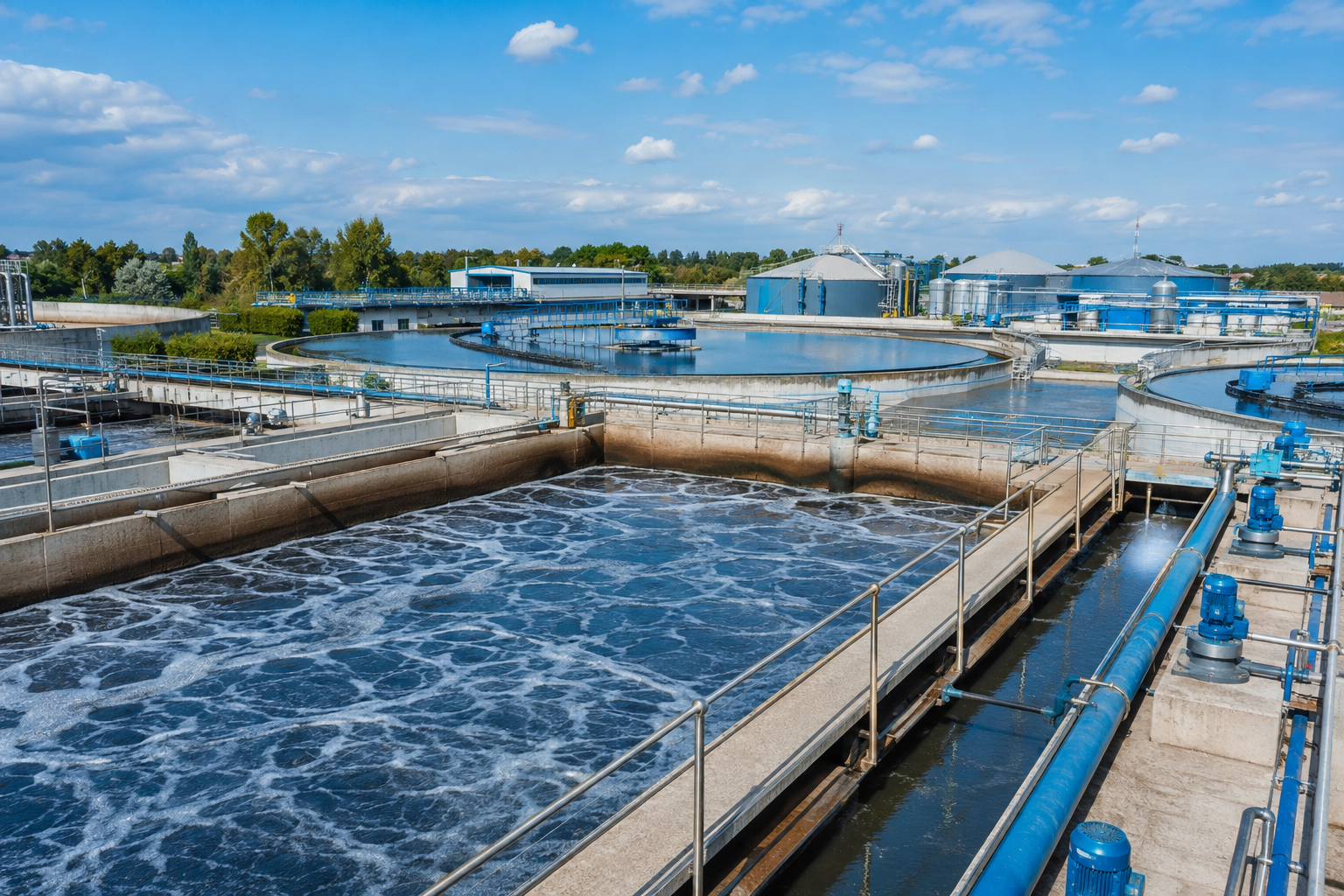
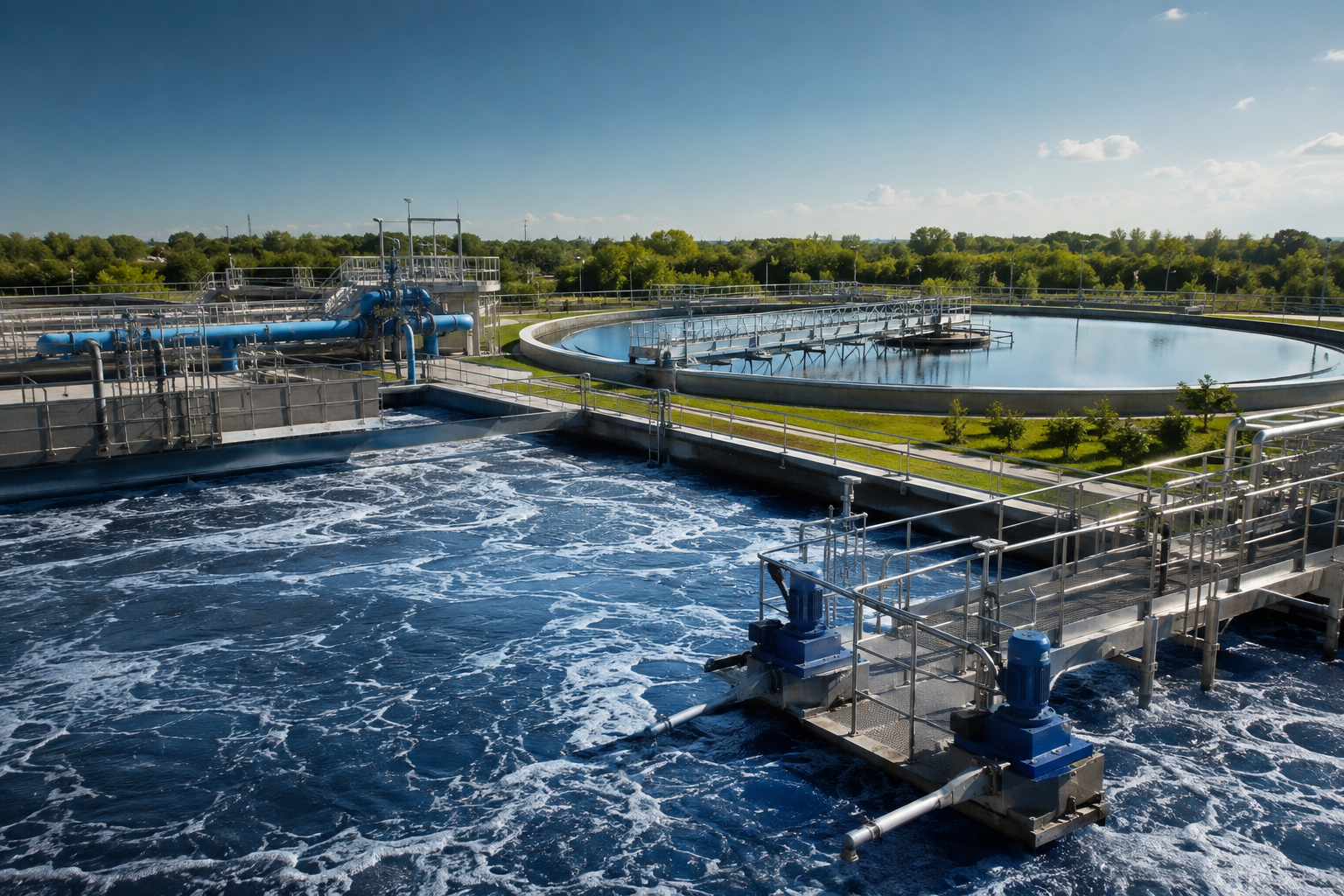
Sewage treatment plant with aeration basins, clarifier tanks and treatment equipment
Wastewater treatment systems

Sewage Treatment Plant

Engineered treatment for responsible discharge, reliable reuse and a cleaner water future.

The treatment process

How an STP works

A modern Sewage Treatment Plant generally consists of several connected stages, each with a defined treatment purpose.

01

Preliminary Treatment

Screens and grit-removal systems remove large solids, plastics, sand and other coarse materials.

02

Primary Treatment

Suspended solids and settleable organic matter are removed through sedimentation.

03

Biological Treatment

Microorganisms break down dissolved and biodegradable organic pollutants.

04

Secondary Clarification

Biological solids are separated from the treated wastewater.

05

Tertiary Treatment

Additional filtration and nutrient or pollutant removal can be provided when higher-quality treated water is required.

06

Disinfection

UV, chlorination or other technologies may be used to reduce pathogens.

07

Sludge Treatment

Sludge is thickened, stabilized, dewatered and managed appropriately.

Why treatment matters

Benefits of sewage treatment

A properly designed STP helps protect the environment while creating more resilient water systems.

Reduces pollution

Of rivers, lakes and groundwater

Protects public health

By treating domestic and municipal wastewater

Enables water reuse

For landscaping, flushing and other suitable applications

Supports compliance

For industries, residential developments and municipalities

Sustainable management

Reduces the environmental impact of untreated sewage

Water-secure future

Converts wastewater into a resource for water reuse

Sustainable water reuse

Wastewater can become a useful resource.

Treated wastewater can potentially be reused for non-potable applications such as gardening, landscaping, toilet flushing, construction and certain industrial processes, subject to the required treatment quality and applicable regulations.

Wastewater
Treatment train
Reusable water
GardeningLandscapingToilet flushingConstructionCertain industrial processes
Our STP solutions

Engineering choices that fit the project.

The right system balances project requirements, wastewater characteristics, available space, desired treated-water quality and reuse objectives.

Building a water-secure future

Well-designed STPs can convert wastewater from an environmental burden into a valuable resource for water reuse.

Plant capacity

MLD / KLD

Treated-water quality

Required outlet quality

Installation area

Available footprint

Energy consumption

Operating requirements

Automation & monitoring

Control and visibility

Sludge management

Stabilization and handling

Water reuse

Reuse objectives

O&M requirements

Long-term operation

One page. Eight treatment approaches.

Types of Sewage Treatment Plants We Provide

Our STPs are engineered according to sewage characteristics, treatment requirements, available space, operating conditions and treated-water reuse objectives.

The approved technical content references CPCB material across these established treatment approaches. Actual treatment performance depends on the upstream biological process, process configuration, operating conditions and required effluent quality.

01

Moving Bed Biofilm Reactor (MBBR)

MBBR uses specially designed bio-media to support microbial growth and biological treatment.

Key advantages
  • Compact plant footprint
  • High biological treatment efficiency
  • Suitable for varying sewage loads
  • Relatively simple operation
  • Suitable for treated-water reuse applications
  • Easy capacity expansion in suitable designs

Applications

Residential complexes, hotels, hospitals, commercial buildings, schools, institutions and industries.

02

SBR Sewage Treatment Plant

Sequencing Batch Reactor (SBR) is a batch-based biological treatment process in which aeration, biological treatment, settling and decanting are carried out in a controlled sequence.

Key advantages
  • Efficient biological treatment
  • Good control of treatment cycles
  • Can provide effective nitrogen removal when appropriately designed
  • Reduced need for separate secondary clarification in many configurations
  • Suitable for projects requiring consistent treated-water quality

Applications

Apartments, townships, hotels, hospitals, institutions and commercial developments.

03

MBR Sewage Treatment Plant

Membrane Bioreactor (MBR) combines biological treatment with membrane filtration to produce high-quality treated wastewater.

Key advantages
  • Excellent suspended-solids removal
  • High-quality treated water
  • Compact footprint
  • Suitable where land availability is limited
  • Suitable for demanding water-reuse applications

Applications

Premium residential projects, hotels, hospitals, commercial complexes, institutions and water-reuse projects.

04

Activated Sludge Process (ASP) STP

ASP is a conventional biological wastewater-treatment technology in which microorganisms break down biodegradable organic matter under controlled aeration.

Key advantages
  • Proven and widely used technology
  • Suitable for a broad range of sewage-treatment applications
  • Well-established operating principles
  • Can be integrated with tertiary treatment and disinfection

Applications

Municipal projects, residential developments, institutions, commercial facilities and large wastewater-treatment systems.

05

Extended Aeration STP

Extended Aeration is a variation of the activated-sludge process that provides longer biological retention and aeration conditions to promote stable treatment.

Key advantages
  • Simple biological treatment process
  • Suitable for relatively consistent sewage characteristics
  • Stable operation when properly designed
  • Suitable for decentralized and smaller-capacity applications

Applications

Residential societies, schools, hospitals, hotels, offices and institutional facilities.

06

UASB-Based Sewage Treatment Plant

Upflow Anaerobic Sludge Blanket (UASB) technology uses anaerobic microorganisms to treat wastewater while producing biogas as a by-product.

Key advantages
  • Anaerobic treatment process
  • Potential for energy recovery through biogas
  • Lower aeration requirement than aerobic biological processes
  • Suitable for appropriate municipal sewage applications

Applications

Large-scale municipal and suitable high-flow sewage-treatment projects.

07

ASP-BNR / Biological Nutrient Removal STP

Biological Nutrient Removal (BNR) processes are designed to provide enhanced removal of nutrients such as nitrogen and, depending on the process configuration, phosphorus.

Key advantages
  • Enhanced nutrient removal
  • Suitable for projects with stringent treated-water requirements
  • Can be combined with tertiary filtration and disinfection
  • Supports higher-quality wastewater management

Applications

Projects requiring enhanced nutrient removal and more stringent treated-water requirements.

Advanced polishing

Tertiary treatment & water-reuse systems

Where higher treated-water quality is required, tertiary treatment and disinfection systems can be integrated with the biological STP.

01Pressure Sand Filtration
02Activated Carbon Filtration
03Micron Filtration
04UV Disinfection
05Chlorination
06Advanced filtration systems
07Membrane-based treatment
08Water-recovery and reuse systems
Project selection

Choose the right STP for your project

Our team can evaluate your project requirements and recommend an STP technology that balances treatment performance, footprint, operating requirements, energy consumption and water-reuse objectives.

Selection factors

Sewage flowWater qualityAvailable spaceTreated-water requirementEnergy consumptionCapital costOperating costSludge managementFuture expansion
Where systems make a difference

Applications across communities and industry

STP systems can be designed for a broad range of residential, commercial, institutional, hospitality, healthcare, industrial and municipal requirements.

Residential

Complexes, apartments and townships

Hospitality

Hotels and commercial developments

Healthcare

Hospitals and care facilities

Institutions

Schools and institutional facilities

Industry

Industrial and wastewater-treatment systems

Municipal

Large-scale municipal projects

Need a Water Treatment System for Your Facility?

Talk to our engineering team about your flow rate, water quality and treatment requirements.