
Premium Environmental Solutions Pvt. Ltd.
Circular resource systems

Organic Waste Composter

Smart & Sustainable Organic Waste Management Solutions

Our Organic Waste Composters provide an efficient solution for managing biodegradable and food waste at the source. The system converts segregated organic waste into a stable compost-like organic material through controlled biological decomposition.

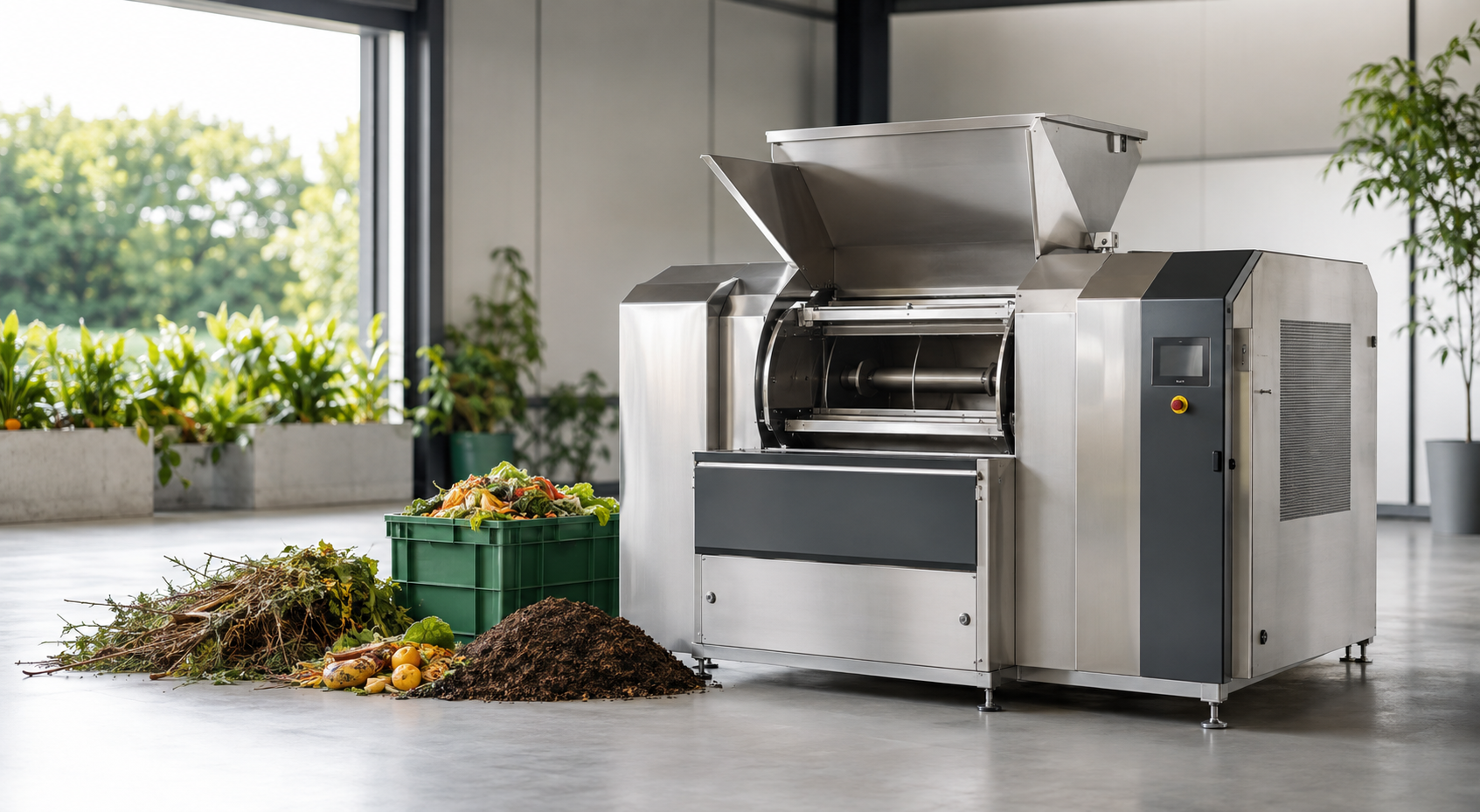
Industrial organic waste composter processing food and garden waste

Resource recovery

Process biodegradable waste closer to its point of generation.

What is an organic waste composter?

Mechanical processing meets biological decomposition.

An Organic Waste Composter is a mechanical and biological waste-processing system that accelerates the natural decomposition of organic waste.

01

Organic Waste

02

Segregation

03

Shredding / Size Reduction

04

Mixing

05

Biological Treatment

06

Curing

07

Screening

08

Compost

The resulting material can be further cured and screened before appropriate use or disposal, according to its quality and applicable requirements.

Six system formats

Types of Organic Waste Composters We Provide

Our composting solutions are designed for residential communities, hotels, restaurants, institutions, commercial facilities, markets, hospitals and other establishments generating biodegradable waste.

01

Automatic Organic Waste Composter

Automatic composting systems are designed for establishments generating regular quantities of food and biodegradable waste.

  • Automated operation options
  • Compact design
  • Controlled mixing
  • Reduced manual handling
  • Suitable for decentralized waste processing
  • Easy-to-manage operating cycles

Applications: Apartments, hotels, restaurants, offices, institutions and commercial facilities.

02

Organic Waste Converter (OWC)

An Organic Waste Converter mechanically processes segregated organic waste to accelerate subsequent biological decomposition.

  • Shredding
  • Mixing
  • Moisture adjustment
  • Biological decomposition
  • Curing

Applications: Used where organic waste needs to be processed close to the point of generation.

03

Food Waste Composter

Food waste composters are designed for biodegradable kitchen and food-service waste.

  • Vegetable waste
  • Fruit waste
  • Food preparation waste
  • Cooked-food waste
  • Garden / leaf waste, depending on system design

Applications: Hotels, restaurants, canteens, food courts, hostels, residential communities and institutions.

04

Kitchen Waste Composter

Kitchen waste composters provide an on-site solution for establishments generating daily kitchen waste.

  • On-site organic-waste processing
  • Reduced handling and transportation
  • Compact installation options
  • Suitable for regular food-waste generation

Applications: Produces a composting material for further curing while reducing the need to transport untreated organic waste to centralized disposal locations.

05

Community / Residential Organic Waste Composter

These systems are designed for housing societies, apartment complexes and residential communities.

  • Sized to average daily quantity
  • Segregated biodegradable waste
  • Decentralized processing
  • Residential campus application

Applications: Housing societies, apartments, townships, gated communities and residential campuses.

06

Commercial Organic Waste Composter

Commercial composting systems are suitable for establishments with larger and continuous organic-waste generation.

  • Configured around available space
  • Configured around waste quantity
  • Configured around operating schedule
  • Suitable for continuous organic-waste generation

Applications: Hotels, malls, restaurants, food-processing facilities, institutions, corporate campuses and commercial complexes.

Organic waste composting process

A visible path from segregation to finished compost.

A typical system follows a structured process. The exact process varies according to equipment configuration and type of organic waste.

01

Segregation

02

Remove Non-Biodegradable Material

03

Shredding / Size Reduction

04

Mixing & Moisture Adjustment

05

Biological Decomposition

06

Curing

07

Screening

08

Finished Compost / Organic Material

Segregation is essential

Know what can—and cannot—be processed.

Proper segregation is essential for efficient operation and good-quality compost.

Suitable organic waste

Vegetable peels
Fruit waste
Food scraps
Cooked-food waste
Kitchen waste
Garden waste
Leaves
Flowers
Other biodegradable organic waste

Materials to keep out

Plastic
Glass
Metal
Batteries
E-waste
Stones
Hazardous waste
Biomedical waste
Chemical waste
Capacity selection

Sized to the measured organic-waste stream.

We can provide composting systems in different capacities according to daily organic-waste generation.

Actual capacity selection should be based on the measured quantity and characteristics of segregated organic waste, rather than the total municipal waste generated at the site. TPD = tonnes per day.

System categoryIndicative daily input
Small25–50 kg/day
Small Commercial50–100 kg/day
Medium100–250 kg/day
Commercial250–500 kg/day
Large500–1,000+ kg/day
Customized Systems1 TPD and above
Equipment details

Features for practical, on-site operation.

Our organic-waste composting solutions can be equipped with a considered combination of processing, monitoring, access and safety features.

Heavy-duty construction
Stainless-steel contact components where required
Automated or semi-automatic operation
Shredding mechanism
Mixing system
Moisture-management arrangement
Temperature monitoring
Odour-control provisions
Easy-access maintenance points
Compact installation options
Electrical control panel
Safety interlocks where applicable
Compost quality

Quality follows the complete processing journey.

The quality of the final compost depends on the feedstock, operation and post-processing conditions.

Compost should be appropriately tested and managed according to its intended application and applicable requirements. For Indian projects, applicable provisions of the Solid Waste Management Rules, 2016, and relevant standards/specifications should be considered during planning and operation.

01Feedstock composition02Waste segregation03Moisture04Aeration05Temperature06Carbon-to-nitrogen balance07Processing time08Curing09Screening10Contamination control
Odour management

Good operation supports better odour performance.

Proper composting requires adequate control of moisture, aeration and organic loading.

Odour performance depends significantly on correct segregation, loading and operation.

Adequate aeration
Controlled moisture
Enclosed processing
Bio-filter systems
Exhaust ventilation
Proper curing
Regular cleaning and maintenance
Automated organic waste management

More visibility for larger installations.

For larger installations, automation can be incorporated for improved process control.

Control-panel operation and data-monitoring options can be selected around the project.

Composter control layer
01PLC-based controls
02Automatic operating cycles
03Temperature monitoring
04Motor protection
05Overload protection
06Alarm indication
07Control-panel operation
08Data monitoring options
Applications

On-site organic-waste processing across facilities

Our Organic Waste Composters are suitable for communities, hospitality, institutions, healthcare, commerce and industrial food-service environments.

Residential Societies

Apartments

Hotels & Resorts

Restaurants

Commercial Complexes

Shopping Malls

Hospitals

Schools & Colleges

Universities

Corporate Offices

Industrial Canteens

Food Courts

Markets

Institutional Campuses

Large Housing Projects

Resource recovery

Reduce waste at source. Recover organic resources.

Processing biodegradable waste at or near the point of generation can reduce the quantity requiring transportation and centralized handling.

Reduce Organic Waste at Source

Process biodegradable waste at or near the point of generation.

Reduce Waste Transportation

On-site processing can reduce the frequency or volume of organic-waste transportation, depending on site arrangement.

Recover Organic Resources

Composting enables recovery of organic matter as a useful soil amendment when the resulting compost meets applicable quality requirements.

Support Sustainable Waste Management

Supports segregation, decentralized processing, resource recovery and circular waste management.

Our organic waste management approach

From waste audit to monitoring and maintenance.

We help organizations manage biodegradable waste responsibly, efficiently and closer to the point of generation.

01

Waste Audit

02

Segregation

03

Capacity Selection

04

Equipment Selection

05

Installation

06

Commissioning

07

Operator Training

08

Monitoring & Maintenance

Customized capacity selection
Compact decentralized solutions
Robust equipment design
Automatic and semi-automatic options
Suitable for residential and commercial applications
Easy operation and maintenance
Organic-waste resource recovery
Odour-control options
Installation and commissioning support
After-sales service

Need a Water Treatment System for Your Facility?

Talk to our engineering team about your flow rate, water quality and treatment requirements.