
Premium Environmental Solutions Pvt. Ltd.
Membrane technology

Reverse Osmosis (RO) Plant

Advanced Reverse Osmosis Solutions for High-Quality Water

We provide industrial, commercial and institutional RO Plants designed to reduce dissolved salts, hardness, minerals and other contaminants from water.

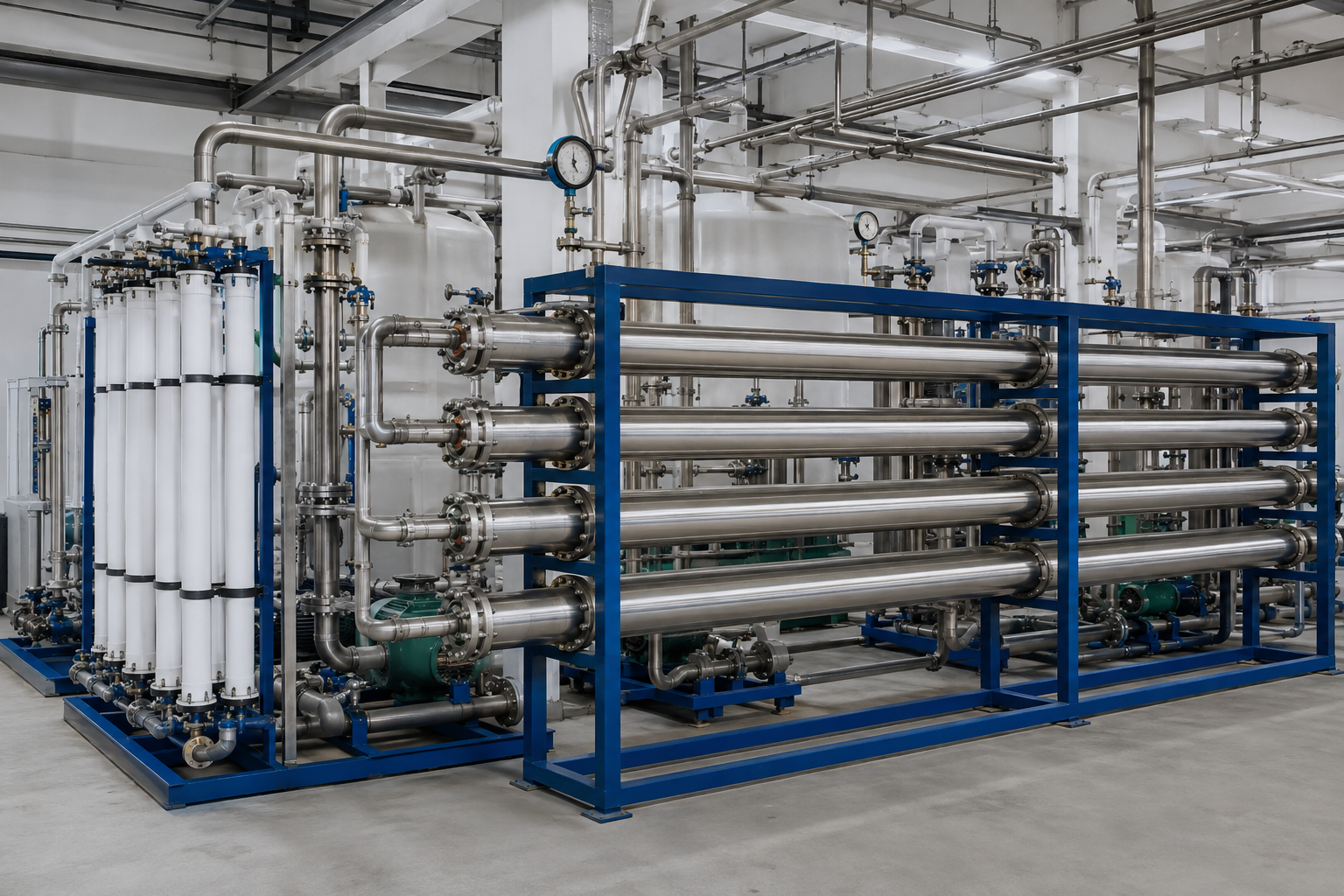
Reverse osmosis plant membrane vessels and treatment skid

Pressure-driven separation

Membrane selection and pretreatment follow the water analysis.

RO overview

High-pressure treatment, precisely configured.

Our RO systems are engineered according to feed-water quality, required product-water quality, flow rate, recovery target and end-use application.

The system can be integrated with pretreatment, filtration, softening, ultrafiltration and post-treatment to achieve the required water quality.

Feed Water
High Pressure
Semi-Permeable Membrane

Permeate / Product Water

The portion of water that passes through the membrane and becomes the treated/product-water stream.

Concentrate / Reject

The portion retained by the membrane and containing a higher concentration of rejected contaminants.

Industrial reverse osmosis system with membrane housings and filtration vessels
Membrane technology

Industrial Reverse Osmosis System

Designed to remove dissolved salts, contaminants and impurities to deliver high-quality process and potable water.

Six RO configurations

Types of RO Plants We Provide

From commercial systems to seawater desalination and water reuse, the configuration is selected around the actual feed water and final application.

01

Commercial RO Plant

Commercial RO systems are designed for businesses and facilities requiring treated water for drinking or general applications.

  • Compact design
  • Automated operation options
  • Multi-stage pretreatment
  • Easy monitoring
  • Suitable for continuous operation

Applications / considerations: Hotels · Restaurants · Schools · Offices · Hospitals · Residential buildings · Commercial facilities

02

Industrial RO Plant

Industrial RO plants are engineered for applications where consistent treated-water quality is required.

  • Manufacturing industries
  • Pharmaceutical industries
  • Chemical industries
  • Food & beverage industries
  • Textile and engineering industries
  • Power and utility applications

Applications / considerations: Customized according to feed-water TDS, hardness, silica, temperature, fouling potential and other water-quality parameters.

03

Brackish Water RO (BWRO) Plant

BWRO systems are designed for water containing elevated dissolved salts, such as certain groundwater and surface-water sources.

  • Borewell water treatment
  • Groundwater purification
  • Industrial water treatment
  • Commercial water supply
  • Process-water production

Applications / considerations: Membrane configuration and operating pressure are selected according to actual feed-water analysis.

04

High-TDS RO Plant

High-TDS water requires careful pretreatment and membrane selection.

  • Multimedia filtration
  • Activated carbon filtration
  • Water softening
  • Antiscalant dosing
  • Cartridge filtration
  • High-pressure pumping
  • Multi-stage membrane systems

Applications / considerations: Final design is based on laboratory water analysis and required recovery and product-water quality.

05

Seawater Reverse Osmosis (SWRO) Plant

SWRO systems are designed to desalinate seawater using specialized membranes and high-pressure equipment.

  • Coastal industries
  • Resorts
  • Ships and marine applications
  • Remote communities
  • Industrial water supply
  • Desalination projects

Applications / considerations: Seawater systems require specialized pretreatment, high-pressure equipment and appropriate concentrate-management arrangements.

06

RO Plant for Water Reuse

RO can be integrated into wastewater-recovery systems to produce water suitable for selected reuse applications.

  • ETP / STP integration
  • Tertiary treatment
  • UF / filtration
  • Treated-water reuse

Applications / considerations: The required process depends on wastewater characteristics and intended reuse application.

Engineering treatment train

RO Plant Process

A typical RO system may consist of the following stages. The exact configuration is customized according to feed-water analysis.

01

Raw Water Tank

02

Feed Pump

03

Multimedia / Pressure Sand Filter

04

Activated Carbon Filter

05

Softener / Antiscalant

06

Cartridge Filter

07

High-Pressure Pump

08

RO Membranes

09

Permeate / Product Water

10

Post-Treatment / Storage

Membrane performance

What does an RO plant remove?

Depending on membrane type and operating conditions, RO can substantially reduce a range of dissolved contaminants.

RO is particularly useful when dissolved-solids reduction is required. However, RO alone should not be assumed to remove every contaminant to the same degree; treatment design should be based on actual water analysis.

Total Dissolved Solids

Dissolved-solids reduction

Dissolved salts

Many dissolved salts can be substantially reduced

Hardness-causing ions

A key reason for membrane treatment

Certain metals

Reduction depends on membrane type and conditions

Many inorganic contaminants

Useful for dissolved-contaminant reduction

Some microorganisms

Performance depends on membrane and operating conditions

Project sizing

RO plant capacity

We can design RO systems according to project requirements, from small commercial systems to large industrial installations.

Capacity ranges are indicative. Actual plant sizing depends on operating hours, peak demand, feed-water quality, recovery, required permeate quality and site conditions.

ApplicationTypical capacity
Small Commercial RO250–2,000 LPH
Commercial RO2,000–10,000 LPH
Industrial RO10,000–100,000+ LPH
Large Industrial SystemsCustomized
BWRO / SWROCustomized according to feed water
Design intelligence

Important RO design parameters

Before designing an RO plant, we evaluate feed-water and operating parameters that influence membrane selection, pretreatment and stability.

01

Feed Flow

Determines plant capacity

02

TDS

Determines membrane selection and system configuration

03

pH

Influences membrane performance and pretreatment

04

Total Hardness

Important for scaling control

05

Alkalinity

Important for scaling assessment

06

Silica

Important for membrane scaling

07

Iron & Manganese

Can cause membrane fouling

08

Turbidity

Determines pretreatment requirements

09

SDI

Important indicator for membrane fouling potential

10

Temperature

Influences membrane performance

11

Chlorine

Must be controlled for chlorine-sensitive membranes

12

Microbiological Quality

Important for biofouling control

Protect the membrane

RO pretreatment is part of the system.

Proper pretreatment is essential for reliable RO operation. For more demanding applications, UF or other advanced pretreatment can be incorporated.

Effective pretreatment helps control scaling, fouling, suspended solids and oxidant exposure, thereby supporting stable membrane operation.

1Pressure Sand Filter
2Activated Carbon Filter
3Softener
4Antiscalant Dosing
5Cartridge Filter
6RO
Recovery logic

Feed becomes permeate plus concentrate.

RO systems produce both permeate and concentrate. Recovery is a design relationship, not a generic fixed percentage.

Recovery formula

Recovery = Permeate Flow ÷ Feed Flow × 100

Feed

Permeate

Treated/product-water stream

Concentrate

Stream containing a higher concentration of rejected contaminants

Achievable recovery depends on water chemistry, scaling potential, membrane configuration and treatment objectives. Higher recovery can reduce reject volume but may increase concentration of scaling-forming constituents.

RO water applications

Designed for the final water application

RO-treated water can be used for suitable applications such as drinking-water production, industrial utilities, process water and reuse systems.

Drinking-water production

Boiler-feed pretreatment

Cooling-water makeup

Process water

Pharmaceutical manufacturing

Food and beverage production

Laboratory applications

Electronics manufacturing

Hotels and hospitals

Water-reuse systems

For drinking-water applications in India, finished water should be tested against applicable requirements, including BIS IS 10500:2012 where applicable. BIS identifies IS 10500:2012 as the Indian Standard for drinking-water requirements and testing.

RO automation

High-pressure treatment with visible control.

Our RO plants can be supplied with automated monitoring and control systems, depending on project requirements.

Instrumentation can support operating visibility, protection, automatic operation and chemical dosing control.

RO control layer
01PLC control
02HMI display
03Flow meters
04Pressure gauges / transmitters
05Conductivity / TDS monitoring
06pH monitoring
07Low-pressure protection
08High-pressure protection
09Auto-flush system
10Automatic valve operation
11Chemical dosing control
12High / low-level controls
Membrane care

Cleaning & maintenance follow operating data.

Regular monitoring and maintenance are important for long-term RO performance.

Membrane cleaning frequency should be determined from actual operating data and fouling/scaling conditions rather than following a single universal schedule.

Feed-water monitoring
Permeate-quality monitoring
Pressure monitoring
Differential-pressure monitoring
Membrane cleaning when required
Cartridge-filter replacement
Antiscalant-system monitoring
Pump inspection
Instrument calibration
Performance trending
Why choose our RO plants?

A membrane system designed around the water.

Our RO solutions are designed to help industries and institutions achieve consistent water quality, dissolved-solids reduction and improved water-use efficiency.

Customized RO system design
Feed-water analysis-based selection
Commercial and industrial solutions
BWRO and seawater RO options
Energy-conscious system design
Automated operation
Multi-stage pretreatment
Water-recovery solutions
RO integration with ETP / STP / UF systems
Installation and commissioning support
Operation and maintenance services
Our RO plant design approach

From water analysis to dependable maintenance

A structured engineering process supports the final RO skid, its pretreatment, membrane selection, commissioning and ongoing monitoring.

01

Water Analysis

02

System Design

03

Pretreatment Selection

04

Membrane Selection

05

RO Skid Design

06

Installation

07

Commissioning

08

Performance Monitoring

09

Maintenance

Need a Water Treatment System for Your Facility?

Talk to our engineering team about your flow rate, water quality and treatment requirements.